We slept in Monday morning, enjoying the quiet of St. Ignace in the off-season. There is always something alluring and peaceful about being in a tourist town when the tourists are all gone. The waterfront seemed quieter than usual and the water shimmered in the morning light. We paid a visit to Java Joe's for some Nutella Crepes and a few leisurely cups of coffee.
After our late breakfast we headed north on I-75 for the final hike on our trip. Near the town of Moran there is a dolomite reef set in a maple forest that is called Maple Hill. I have been meaning to check this strange geological formation out for a while, but by the time we reach St. Ignace we are usually returning from the far north woods and eager for the comforts of civilization. Monday seemed like the perfect day.
The drive out of Moran followed a wide, dusty dirt road for about 9 miles. By the time we reached the trailhead it was hard to imagine anyone had ever been here before us. The air was a solid twenty degrees warmer inland than it was near the water. Loading up my daypack on the side of a hot, dusty road in the mid-day heat really made it feel like summer. A yellow-rumped warbler hopped from branch to branch of a nearby tree while we put on sunscreen and prepared for our hike.
The trail from the forest road to Maple Hill follows a stretch of the North Country Trail. The NCT is a nationally-recognized scenic trail, like the Appalachian Trail, Pacific Crest Trail and Continental Divide Trail, among others. However, the NCT is a more recent idea, and as such it is still under development. It runs from Lake Champlain in eastern New York, through Pennsylvania, Ohio, Michigan, Wisconsin, Minnesota and North Dakota. Many stretches of it still require road walking, and only a few hardy souls have undertaken a thru-hike on this trail.
The word "trail" was really an exaggeration for this section. The only evidence of a route through the forest were the occasional blue blazes painted onto the maple trees. The blazes were frequent enough that as long as we were vigilant in looking for the next blaze before proceeding, we weren't really in any danger of getting lost. The surface of the trail, however, was the forest floor, with no visible path. Trillium covered the forest in all directions, although not in bloom yet. In another week this looked to be a fabulous wildflower hike! The forest was completely deciduous. Most of the trees had a colorful splash of buds growing, but no leaves yet. This created an open, airy feeling, and made the sun feel as it if was beating down directly on us. Occasionally, the forest floor would be flooded, making it necessary to pick our way over downed trees and other obstacles to stay dry.
The trail crossed a few forest roads as it ambled north-east. We heard the load hammering of a pileated woodpecker several times during our hike. A little over four miles into our hike the trail climbed gradually, reaching the escarpment of Maple Hill. This formation was more impressive in person that pictures can convey. It ran for about a half-mile, climbing 15-20 feet over the trail. The air up against the rock formation was noticeably cooler. This dolomite reef is part of the Niagara Escarpment, a formation that runs from Niagara Falls in the East, all the way to the edge of the plains in the West. This section really was reminiscent of the parts of the Pictured Rocks Lakeshore that move inland, away from the water. Similar low cliffs set in a deciduous forest predominate that area as well.
We took a few picture before beginning the return hike. The dolomite reef was worth the excursion, but the rest of the hike was a bit monotonous. The scenery seldom changed, and the forest was hot without the shade from leave cover. We returned to the Jeep a little less than four hours after we had left, not bad for an 8.6 mile hike. We decided to take a scenic route back to St. Ignace, driving along Brevort Lake and and Lake Michigan along US-2. The skies were bright blue and the sun hot overhead. It really felt like summer had arrived.
After a stop for dinner at the Mackinaw Grille we made the crossing over the bridge. The sun was still high in the sky to the west, and Lake Michigan shimmered in a golden light, the water calm and inviting. It is always hard to drive south across the bridge, but at least in the spring we know that we won't have to wait long to return! For the moment, it was time to head home and finish our summer planning. The end of the school year is right around the corner, and we have a bunch of plans to finish.
Wednesday, May 8, 2013
Monday, May 6, 2013
Pigeon River State Forest Day 2
It was a truly beautiful night in the forest. We had a canopy of shimmering stars overhead and the steady drone of frogs from the lake throughout the evening. The tranquility of the forest was broken only by the occasional call of the barred owl and splash of the beaver's tail. The occupant of the large beaver lodge near our campsite made his first appearance at dusk and paddled a nightman's watch throughout the night.
The air grew cold in the night and I found myself regretting the decision to leave the zero degree sleeping bags behind on this trip. When the sun finally broke over the far shore in a hundred shades of orange and red it was a welcome sight.
We slept in late, enjoying the quickly warming air in our cozy two person sleeping bag. When the air was finally warm enough we crawled out of the tent to find a gorgeous morning scene playing out on the lake. We fixed coffee and oatmeal for breakfast before packing up camp. It was almost noon by the time we were back on the trail.
The hike quickly climbed a forested ridge north of Grass Lake. A short side trail lead to an overlook of the lake with a large wooden bench. The trees below the ridge must have grown considerably since the bench was placed, as the lake was now mostly concealed from view. It was still a pleasant point for a break, providing some perspective on the size of the state forest area we were circling.
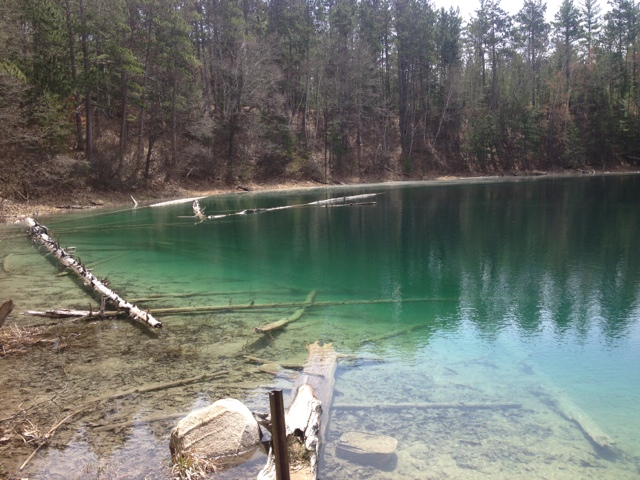
This was the only significant climb of the day (by Midwest standards), but the trail continued to rise and fall gradually as it worked its way around a number of quiet backwoods lakes before returning to the shores of the Pigeon River. We stopped for another break at Section 4 Lake, which is actually quite a bit more charming than its name lets on. Set in a strange bowl with steep edges 15-20 feet in height, section 4 lake has turquoise water reminiscent of the glacial lakes I've seen out west.
Shortly after reaching the edges of the river again, the trail began crossing a series of open, grassy fields. We hoped these openings would allow us a glimpse of the area's elk herd, but to no avail. The unfortunate side effect of these fields, however, were the deer ticks which had just hatched, it seemed. We started noticing several of the creepy bugs on our legs and boots as we hiked. These little terrors can transmit Lyme disease, and are crafty at getting onto the body and not getting noticed. We hiked the rest of the loop in record time, eager to get out of these fields!
Once back to the Jeep we carefully changed out of our hiking clothes, taking care to remove any ticks we had picked up on our clothes and bodies. After a very meticulous process of changing and packing up in the parking lot, we were on the road. We stopped at a gas station for cold drinks and decided to take the top off of the Jeep for the first time this season. The weather was picture-perfect, with bright sunny skies and temps in the high 70's.
Our destination for the night was Saint Ignace for a night in the Driftwood Motel, but we decided to take the scenic route along backroads to Cheboygan. With the Tigers game on the radio and the top off the Jeep it was a beautiful Sunday drive. The couple of trucks that passed us were the only signs of civilization we saw on the hour and half drive through the quiet backwoods. The buds on the trees were quickly exploding into full grown leaves, and their current condition looked like a Monet watercolor, with pastel colors that seemed too colorful to be real. In a couple of places the road was washed out, giving us an excuse to fire up the four-wheel drive.
Eventually the dirt road linked up with M-33, and we cruised into Cheboygan, and then along the lakeshore to Mackinaw City. The air rapidly grew cold along the lakeshore, and by the time we were crossing the bridge temps were in the low 50's. We were both shivering by the time we pulled into the motel parking lot.
We spent our Sunday night enjoying Whitefish while watching hockey and playing a little shuffleboard in the bar. Not bad for a Sunday Night! It was great to be back in the UP, which seemed to be reaching spring just in time. The waters of Lake Huron shimmered in the fading daylight as a lonely ferry cruised towards Mackinac Island. Summer really was right around the corner.
The air grew cold in the night and I found myself regretting the decision to leave the zero degree sleeping bags behind on this trip. When the sun finally broke over the far shore in a hundred shades of orange and red it was a welcome sight.
We slept in late, enjoying the quickly warming air in our cozy two person sleeping bag. When the air was finally warm enough we crawled out of the tent to find a gorgeous morning scene playing out on the lake. We fixed coffee and oatmeal for breakfast before packing up camp. It was almost noon by the time we were back on the trail.
The hike quickly climbed a forested ridge north of Grass Lake. A short side trail lead to an overlook of the lake with a large wooden bench. The trees below the ridge must have grown considerably since the bench was placed, as the lake was now mostly concealed from view. It was still a pleasant point for a break, providing some perspective on the size of the state forest area we were circling.
This was the only significant climb of the day (by Midwest standards), but the trail continued to rise and fall gradually as it worked its way around a number of quiet backwoods lakes before returning to the shores of the Pigeon River. We stopped for another break at Section 4 Lake, which is actually quite a bit more charming than its name lets on. Set in a strange bowl with steep edges 15-20 feet in height, section 4 lake has turquoise water reminiscent of the glacial lakes I've seen out west.
Shortly after reaching the edges of the river again, the trail began crossing a series of open, grassy fields. We hoped these openings would allow us a glimpse of the area's elk herd, but to no avail. The unfortunate side effect of these fields, however, were the deer ticks which had just hatched, it seemed. We started noticing several of the creepy bugs on our legs and boots as we hiked. These little terrors can transmit Lyme disease, and are crafty at getting onto the body and not getting noticed. We hiked the rest of the loop in record time, eager to get out of these fields!
Once back to the Jeep we carefully changed out of our hiking clothes, taking care to remove any ticks we had picked up on our clothes and bodies. After a very meticulous process of changing and packing up in the parking lot, we were on the road. We stopped at a gas station for cold drinks and decided to take the top off of the Jeep for the first time this season. The weather was picture-perfect, with bright sunny skies and temps in the high 70's.
Our destination for the night was Saint Ignace for a night in the Driftwood Motel, but we decided to take the scenic route along backroads to Cheboygan. With the Tigers game on the radio and the top off the Jeep it was a beautiful Sunday drive. The couple of trucks that passed us were the only signs of civilization we saw on the hour and half drive through the quiet backwoods. The buds on the trees were quickly exploding into full grown leaves, and their current condition looked like a Monet watercolor, with pastel colors that seemed too colorful to be real. In a couple of places the road was washed out, giving us an excuse to fire up the four-wheel drive.
Eventually the dirt road linked up with M-33, and we cruised into Cheboygan, and then along the lakeshore to Mackinaw City. The air rapidly grew cold along the lakeshore, and by the time we were crossing the bridge temps were in the low 50's. We were both shivering by the time we pulled into the motel parking lot.
We spent our Sunday night enjoying Whitefish while watching hockey and playing a little shuffleboard in the bar. Not bad for a Sunday Night! It was great to be back in the UP, which seemed to be reaching spring just in time. The waters of Lake Huron shimmered in the fading daylight as a lonely ferry cruised towards Mackinac Island. Summer really was right around the corner.
Saturday, May 4, 2013
Pigeon River State Forest
Some days, backpacking is hard. The weather is too hot, or too cold, or too rainy. The bugs are bad. The trail harder than expected. Then, there are days like today.
As I write this we are relaxing in our tent, camped a few feet from the shore of a beautiful, secluded lake. Our dinner entertainment consisted of watching a pair of loons on the lake fish for their supper while bald eagles circled overhead. Not a bad day at all.
The day started with a 7 am alarm, bagels from Big Apple Bagels and doughnuts from Uncle John's Cider Mill in St. John's, which had just opened for the season. Traffic was light and we made it to the trailhead east of Vanderbilt by noon.
Our plan was to tackle the Shingle Mill Pathway, a ten mile loop hike through the wooded hills of the Pigeon River State Forest. Normally, the hike is done in a counter-clockwise direction, allowing hikers to camp near Grass Lake about 6 miles in. On a previous trip we discovered an "unofficial" campsite right on a pretty lake, about 7 miles around the loop. We had our sights set on finding this campsite again.
When we reached the trailhead the parking lot was almost full, which was not surprising considering the beautiful spring weather. We figured other hikers were likely to take our campsite if they got there first, so we elected for a clockwise hike instead. This would put us at the site in a mere 3 miles, leaving us 7 for Sunday.
The hike was incredibly pleasant, with mostly sunny skies overhead and temperatures in the mid-seventies. The mostly level trail followed the fast-flowing, crystal clear waters of the Pigeon River for a while. After a mile or so it left the river, passing through a mixture of mature pine and hardwood forests and the occasional field of saplings sprouting up out of previously logged areas. A variety of birds darted across the trail as we hiked. We saw a number of flickers, and a hairy woodpecker. A pileated woodpecker was hammering away at a decaying old tree as we passed.
We reached the campsite in the early afternoon, finding it unoccupied. We set up our tent right on the shore and spent the rest of the afternoon watching the resident wildlife go about its business on the lake. A large beaver lodge sat a few feet from our campsite, and the lake had a pair of loons fishing on it throughout the day. There are few things more enchanting than the haunting call of the loon.
As the sun dropped out of sight in the woods behind us it cast a golden haze on the trees and water of the opposite shore. We enjoyed our Mac and cheese with a couple travel-sized plastic bottles of wine (high class backcountry fare!) while watching the daylight fade. Several parties of disappointed hikers passed by in the evening, validating our decision.
I'm hoping we'll be treated to some evening music by the owl population tonight. The campsite has plenty of evidence of owl activity. All in all, it was a magical day to be outdoors.
As I write this we are relaxing in our tent, camped a few feet from the shore of a beautiful, secluded lake. Our dinner entertainment consisted of watching a pair of loons on the lake fish for their supper while bald eagles circled overhead. Not a bad day at all.
The day started with a 7 am alarm, bagels from Big Apple Bagels and doughnuts from Uncle John's Cider Mill in St. John's, which had just opened for the season. Traffic was light and we made it to the trailhead east of Vanderbilt by noon.
Our plan was to tackle the Shingle Mill Pathway, a ten mile loop hike through the wooded hills of the Pigeon River State Forest. Normally, the hike is done in a counter-clockwise direction, allowing hikers to camp near Grass Lake about 6 miles in. On a previous trip we discovered an "unofficial" campsite right on a pretty lake, about 7 miles around the loop. We had our sights set on finding this campsite again.
When we reached the trailhead the parking lot was almost full, which was not surprising considering the beautiful spring weather. We figured other hikers were likely to take our campsite if they got there first, so we elected for a clockwise hike instead. This would put us at the site in a mere 3 miles, leaving us 7 for Sunday.
The hike was incredibly pleasant, with mostly sunny skies overhead and temperatures in the mid-seventies. The mostly level trail followed the fast-flowing, crystal clear waters of the Pigeon River for a while. After a mile or so it left the river, passing through a mixture of mature pine and hardwood forests and the occasional field of saplings sprouting up out of previously logged areas. A variety of birds darted across the trail as we hiked. We saw a number of flickers, and a hairy woodpecker. A pileated woodpecker was hammering away at a decaying old tree as we passed.
We reached the campsite in the early afternoon, finding it unoccupied. We set up our tent right on the shore and spent the rest of the afternoon watching the resident wildlife go about its business on the lake. A large beaver lodge sat a few feet from our campsite, and the lake had a pair of loons fishing on it throughout the day. There are few things more enchanting than the haunting call of the loon.
As the sun dropped out of sight in the woods behind us it cast a golden haze on the trees and water of the opposite shore. We enjoyed our Mac and cheese with a couple travel-sized plastic bottles of wine (high class backcountry fare!) while watching the daylight fade. Several parties of disappointed hikers passed by in the evening, validating our decision.
I'm hoping we'll be treated to some evening music by the owl population tonight. The campsite has plenty of evidence of owl activity. All in all, it was a magical day to be outdoors.
Friday, May 3, 2013
Changing Destinations for the Weekend
In southern Michigan spring has finally sprung. We had our first 80 degree day recently and the long dormant deciduous trees have exploded into life. I awoke this morning to the dawn chorus of bird song outside my window at 5:30 AM, a sure sign that winter is behind us. Unfortunately, winter hasn't quite given up on the places north of us! A recent winter storm dumped as much as 20 inches of snow in portions of the Rocky Mountains. Michigan's UP was sparred the heavy accumulation, but most of the trails are still buried beneath an annoying snow pack. We found last weekend that the lingering snow pack is softening up, which actually makes it harder to hike on, as every other step sinks into the slush, soaking boots and socks. With that in mind, we have decided to change our destination for this weekend. The Pictured Rocks Lakeshore will have to wait for a warmer weekend.
Instead, we will do some backpacking in the Pigeon River State Forest, north of Gaylord in the the lower peninsula. This area is actually the largest wilderness area south of the bridge, and contains a surprising amount of elevation change, and plenty of wildlife. The rolling hills are home to everything from black bears and bobcats to a large number of bird species. With any luck we may even spot some members of Michigan's only elk herd. We'll head up first thing in the morning Saturday, and I'll post updates and pictures throughout the weekend. It's shaping up as a beautiful weekend across much of the region, so hopefully you'll be able to get outside too! Happy Spring Everyone!
Sunday, April 28, 2013
Whitefish Point Bird Observatory Trip
The weather downstate gave us a beautiful send off Friday afternoon, with bright blue skies overhead and warm sunshine streaming through the windshield as we raced north on US 127. Although we were some 300 odd miles away from the Whitefish Point Bird Observatory, the birding started in earnest. We witnessed both an immature bald eagle and an osprey from the highway. Hopefully both would be good signs for our weekend.
The weather remained beautiful throughout our drive to the straits of Mackinaw. As we passed Gaylord patches of snow began to appear on the north facing hillsides, most notably in the Pigeon River Area. We had heard reports of miserable weather and heavy snow for the past few days in the upper peninsula, so were weren't exactly sure what we would find as we drove further north.
As we rounded one of the bends on I75 the majestic towers of the Mackinaw Bridge came into view. They looked hazy and more distant than I recalled, standing watch over the still frigid waters in the fading daylight. We've crossed the bridge too many times too count, but it never loses its fascination for me. Flashing road signs warned of high winds as we approached the water's edge.
During our crossing we were treated to the sight of a ferry cruising east towards the islands. The water was calm enough that the giant ship's wake lingered far to the west in Lake Michigan. As we descended towards Saint Ignace, the low, pine covered coast of the upper peninsula came into view. It was like seeing an old friend after too many months apart for me. Somehow, it had been almost 8 months since we last visited. Too long to stay away from the quiet forests and mesmerizing waters!
We stopped off in St. Ignace for dinner at the Driftwood Inn. It was still too early for most tourists, so we did our best to blend in with the locals. We've actually been confused for locals in the past at the Driftwood, an indication that we might have been frequenting the place a bit too much! An all-you-can-eat buffet complete with hush puppies, whitefish and perch was the special for the night, and we happily partook.
After eating and watching a couple innings of the Tigers' route of Atlanta we were back on the road and heading further north. The forest grew quickly dark on either side of the road. It was hard to tell how much snow there was in the dark.
A little after ten we pulled into the parking lot of the Vagabond Motel in Paradise, MI. The woman working behind the desk looked relieved to see us, as we were the last customers to arrive for the night. Presumably, her work day didn't end until we arrived. We were planning to camp at the River mouth Campground south of Paradise, but weren't sure of its status in light of all of the snow. A quick drive through the campground confirmed our decision. Drifts of snow piled high by snowplows had turned the campground loops into tunnels, and the campsites themselves were buried under a hard snow pack. It continues to be an epically terrible spring for hiking and camping!
The alarm went off at 6 am Saturday morning. The drive north to Whitefish Point from Paradise is about 10 miles, and we wanted to be at the point in time for the early morning bird walks lead by the WPBO volunteers. The sun had just risen above the tranquil waters of the Whitefish Bay when we drove out of town.
Whitefish Point was truly spectacular on this early spring morning. The air was cold and crisp, but the winds were warm and from the south, and the sand dunes and birch trees were awash in sunlight. It felt as if the world was finally shaking off a long, frozen winter. The parking lot was overflowing with cars, and everyone seemed happy to be outdoors and looking for birds. There is something therapeutic about spending time with the type of people that are willing to drive hundreds of miles in order to crawl out of bed in the pre-dawn dark and stand around in freezing temperatures all to look at some birds.
I am, at best, a novice birder, and it is always both nice to spend time with veteran birders, and at the same time a bit intimidating. We purchased some muffins and coffee from the makeshift tent the WPBO volunteers had assembled and took a leisurely walk around the point. A ferry was headed to the west, towards Grand Marais. A few sharp-skinned hawks were already flitting about in the breeze, although the best of the aerial show would wait until the air warmed up in the afternoon.
At 8 AM we joined the guided walk out to the point where the waterbird count was being conducted. The WPBO volunteer who lead the birding walk was very informative and helpful. He gave the group a number of tips to help us identify the birds we were likely to see during the weekend. The walk to the point took us through a small forest of jack pine trees. He told us that there were probably hundreds of Sawhet and Borreal Owls roosted in this forest for the day, but "good luck finding one." It was neat to think about these tiny nocturnal predators being mere feet from us as we walked over the hard packed snow and sand.
At the point there was a small shack where the official waterbird count was maintained. A rugged looking man from New Jersey was manning the post this season. He and some other volunteers had a number of scopes set up on tripods to use in the identification of the passing birds. We were able to see a couple of interesting species in the surf while we were at the point: Common Mergansers, Common Loons, and Red-Necked Grebes. During the walk, our guide relayed interesting facts and stories about the migration. The violent nature of the animal world was a central theme. He said there was a group of birders watching a song sparrow at one of the feeders near the WPBO headquarters when a sharp skinned hawk zipped by and took the bird for breakfast, leaving behind a little cloud of feathers. He had other stories of a similar nature: in the fall, some of the hawks will hang out at the point waiting for migrating birds to complete the arduous crossing. Often a red breasted nuthatch, or some other song bird will finish the crossing exhausted, only to be picked off as an easy snack by a bird of prey. Such is the day to day existence of the natural world.
After touring the lakeshore the group walked back through the jack pine forest. A scattering of flickers passed over head, a common bird for the weekend's migration. The small, woodpecker like birds looked a bit like torpedos zooming through the air.
While we were on our walk, the guide also clued us all in on an unusual bird sighting in the area. A Townsend Solitaire had been seen at the State Harbor, about three miles south of the point. The Solitaire is a thrush that is common in the west and only makes the occasional appearance east of the Mississippi. He advised us all to check it out at some point during the weekend. On our drive back to Paradise we pulled into the harbor. Sure enough, several more serious birders had scopes set up, watching the rare bird. This made for an easy sighting for us less experienced folks. After being sure to write down the unusual sighting in my records, we headed south for a late breakfast at the Berry Patch Restaurant.
Next, we decided to head a little further south of town to check out the Tahquamenon River Mouth Area. This part of one of MIchigan's largest state parks is where the mighty Tahquamenon River empties into Lake Superior. This meeting of bodies of water provides a great vantage point for a number of water birds. We were not the only birders with this idea. Cars lined the sides of M-123 and birders with scopes were set up on both sides of the road. My less-powerful binoculars made birding at such a distance more difficult, but I was able to sight a number of scaup, multiple species of Mergansers, and some swans. Identifying the swans from a distance was difficult, so I'm not sure if they were Trumpeter Swans or the more exotic Tundra Swans, which multiple birders had seen in the area recently
The afternoon air had warmed considerably, and it was now possible to shed the winter coats, hats and gloves. We returned to Whitefish Point to check out the Hawk Platform. The warm air and southerly breeze had produced the best travel conditions of the season for the large birds. Standing on the hawk platform provided views in almost 360 degrees, making for the ideal spot to watch for migrating hawks. I like to think of this as birding on steroids, and it was the real reason that so many birders had come from so far away for the weekend. If I trained my binoculars on a large bird circling in the distance, I would find dozens more, either farther off or higher up. The skies were awash in large birds. Turkey vultures, red-tailed hawks, broad winged hawks, rough-legged hawks, Northern Harriers, Kestrels, and too many sharp skinned hawks to count circled above. Cory, the man in charge of the hawk count this season employed a number of scopes and binoculars to document the migration. By the end of the day he counted more than 1,300 sharp skinned hawks passing the point, and over 2,000 large birds in all. Several Bald Eagles, and a Golden Eagle made appearances. Near the end of the afternoon a Peregrine Falcon zipped by overhead. A number of Sandhill Cranes passed throughout the day, traveling in formation like a squadron of bombers. As the air grew cooler the activity level began to fall, but it was an impressive day to witness.
We decided to make the drive out to the Tahquamenon Falls in the evening. The Tahquamenon Falls Brewery is located right at the State Park. The brewery has the best food in the area (which isn't really saying a great deal - Paradise isn't exactly known as a foodie destination!) and brews their own beers. We enjoyed some more Great Lakes fish for dinner and took an after dinner walk down to the falls. The air away from the lake was downright balmy! The river swelled with snowmelt, the upper falls were the biggest I had ever seen.
After our dinner and walk, we returned to the hotel in Paradise and watched some of the Red Wings while waiting for it to grow dark. Whitefish Point is a natural geographic funnel for migrating birds, and this phenomenon is not just limited to diurnal birds. A large variety of owls pass over the point each night in the spring. Birders have been known to spot everything from Sawhet Owls, Short-Eared Owls, Long-Eared Owls, Boreal Owls, and Barred Owls to even Great Gray Owls and the occasional Snowy Owls. Needless to say, I was excited to return at dusk and check out the scene.
Viewing from the platform was standing room only, as dozens of birders strained their eyes peering into the twilight for shapes moving. Eventually, someone would spot an owl and attempt to describe its location to the rest of the group. While we were there we witnessed several long-eared owls passing overhead. One of them was "crabbing" meaning its head was looking at us, but it was flying away from us towards the crossing. This is a pretty cool trick that owls can do.
Once the last of the day's light had faded the crowds dispersed. We walked down to the owl banding shack and waited with a few other hardy birders to see if the owl banders would bring any captured birds back for us to see. After a few minutes, they came out of the building. They said they would check the nets to see if anything had been caught, and if they had any they would bring them back to show us in a few minutes. We waited in the chilly night air as the sky overhead filled with stars. It was one of the best night skies I have seen in a while.
When one of the banders returned empty handed we thought we were out of luck. She reached into her pocked and pulled out a tube-shaped container about half as big as a Pringles Can. At first I thought she had a feather, until she pulled a Sawhet Owl out of the tube! Holding it by its feet, she held it up to show the crowd. The little bird shook off its feathers and looked at us with an expression of bewilderment. Another man returned from the forest with what looked like a soft sided cooler. One of the birders referred to it as a six pack. Sure enough, he pulled out several small owls.
The WPBO staff attach small identification bands to the birds and then release them back into the wilds. This is all part of an effort to document the distribution and migration of owls in the region. It was by far one of the coolest things I have ever witnessed. We drove back to the hotel under a beautiful night sky. It was a full day of fresh air, beautiful weather, and birds galore. The Whitefish Point Bird Observatory's Spring Fling was worth making the long drive!
The weather remained beautiful throughout our drive to the straits of Mackinaw. As we passed Gaylord patches of snow began to appear on the north facing hillsides, most notably in the Pigeon River Area. We had heard reports of miserable weather and heavy snow for the past few days in the upper peninsula, so were weren't exactly sure what we would find as we drove further north.
As we rounded one of the bends on I75 the majestic towers of the Mackinaw Bridge came into view. They looked hazy and more distant than I recalled, standing watch over the still frigid waters in the fading daylight. We've crossed the bridge too many times too count, but it never loses its fascination for me. Flashing road signs warned of high winds as we approached the water's edge.
During our crossing we were treated to the sight of a ferry cruising east towards the islands. The water was calm enough that the giant ship's wake lingered far to the west in Lake Michigan. As we descended towards Saint Ignace, the low, pine covered coast of the upper peninsula came into view. It was like seeing an old friend after too many months apart for me. Somehow, it had been almost 8 months since we last visited. Too long to stay away from the quiet forests and mesmerizing waters!
We stopped off in St. Ignace for dinner at the Driftwood Inn. It was still too early for most tourists, so we did our best to blend in with the locals. We've actually been confused for locals in the past at the Driftwood, an indication that we might have been frequenting the place a bit too much! An all-you-can-eat buffet complete with hush puppies, whitefish and perch was the special for the night, and we happily partook.
After eating and watching a couple innings of the Tigers' route of Atlanta we were back on the road and heading further north. The forest grew quickly dark on either side of the road. It was hard to tell how much snow there was in the dark.
A little after ten we pulled into the parking lot of the Vagabond Motel in Paradise, MI. The woman working behind the desk looked relieved to see us, as we were the last customers to arrive for the night. Presumably, her work day didn't end until we arrived. We were planning to camp at the River mouth Campground south of Paradise, but weren't sure of its status in light of all of the snow. A quick drive through the campground confirmed our decision. Drifts of snow piled high by snowplows had turned the campground loops into tunnels, and the campsites themselves were buried under a hard snow pack. It continues to be an epically terrible spring for hiking and camping!
The alarm went off at 6 am Saturday morning. The drive north to Whitefish Point from Paradise is about 10 miles, and we wanted to be at the point in time for the early morning bird walks lead by the WPBO volunteers. The sun had just risen above the tranquil waters of the Whitefish Bay when we drove out of town.
Whitefish Point was truly spectacular on this early spring morning. The air was cold and crisp, but the winds were warm and from the south, and the sand dunes and birch trees were awash in sunlight. It felt as if the world was finally shaking off a long, frozen winter. The parking lot was overflowing with cars, and everyone seemed happy to be outdoors and looking for birds. There is something therapeutic about spending time with the type of people that are willing to drive hundreds of miles in order to crawl out of bed in the pre-dawn dark and stand around in freezing temperatures all to look at some birds.
I am, at best, a novice birder, and it is always both nice to spend time with veteran birders, and at the same time a bit intimidating. We purchased some muffins and coffee from the makeshift tent the WPBO volunteers had assembled and took a leisurely walk around the point. A ferry was headed to the west, towards Grand Marais. A few sharp-skinned hawks were already flitting about in the breeze, although the best of the aerial show would wait until the air warmed up in the afternoon.
At 8 AM we joined the guided walk out to the point where the waterbird count was being conducted. The WPBO volunteer who lead the birding walk was very informative and helpful. He gave the group a number of tips to help us identify the birds we were likely to see during the weekend. The walk to the point took us through a small forest of jack pine trees. He told us that there were probably hundreds of Sawhet and Borreal Owls roosted in this forest for the day, but "good luck finding one." It was neat to think about these tiny nocturnal predators being mere feet from us as we walked over the hard packed snow and sand.
At the point there was a small shack where the official waterbird count was maintained. A rugged looking man from New Jersey was manning the post this season. He and some other volunteers had a number of scopes set up on tripods to use in the identification of the passing birds. We were able to see a couple of interesting species in the surf while we were at the point: Common Mergansers, Common Loons, and Red-Necked Grebes. During the walk, our guide relayed interesting facts and stories about the migration. The violent nature of the animal world was a central theme. He said there was a group of birders watching a song sparrow at one of the feeders near the WPBO headquarters when a sharp skinned hawk zipped by and took the bird for breakfast, leaving behind a little cloud of feathers. He had other stories of a similar nature: in the fall, some of the hawks will hang out at the point waiting for migrating birds to complete the arduous crossing. Often a red breasted nuthatch, or some other song bird will finish the crossing exhausted, only to be picked off as an easy snack by a bird of prey. Such is the day to day existence of the natural world.
After touring the lakeshore the group walked back through the jack pine forest. A scattering of flickers passed over head, a common bird for the weekend's migration. The small, woodpecker like birds looked a bit like torpedos zooming through the air.
While we were on our walk, the guide also clued us all in on an unusual bird sighting in the area. A Townsend Solitaire had been seen at the State Harbor, about three miles south of the point. The Solitaire is a thrush that is common in the west and only makes the occasional appearance east of the Mississippi. He advised us all to check it out at some point during the weekend. On our drive back to Paradise we pulled into the harbor. Sure enough, several more serious birders had scopes set up, watching the rare bird. This made for an easy sighting for us less experienced folks. After being sure to write down the unusual sighting in my records, we headed south for a late breakfast at the Berry Patch Restaurant.
Next, we decided to head a little further south of town to check out the Tahquamenon River Mouth Area. This part of one of MIchigan's largest state parks is where the mighty Tahquamenon River empties into Lake Superior. This meeting of bodies of water provides a great vantage point for a number of water birds. We were not the only birders with this idea. Cars lined the sides of M-123 and birders with scopes were set up on both sides of the road. My less-powerful binoculars made birding at such a distance more difficult, but I was able to sight a number of scaup, multiple species of Mergansers, and some swans. Identifying the swans from a distance was difficult, so I'm not sure if they were Trumpeter Swans or the more exotic Tundra Swans, which multiple birders had seen in the area recently
The afternoon air had warmed considerably, and it was now possible to shed the winter coats, hats and gloves. We returned to Whitefish Point to check out the Hawk Platform. The warm air and southerly breeze had produced the best travel conditions of the season for the large birds. Standing on the hawk platform provided views in almost 360 degrees, making for the ideal spot to watch for migrating hawks. I like to think of this as birding on steroids, and it was the real reason that so many birders had come from so far away for the weekend. If I trained my binoculars on a large bird circling in the distance, I would find dozens more, either farther off or higher up. The skies were awash in large birds. Turkey vultures, red-tailed hawks, broad winged hawks, rough-legged hawks, Northern Harriers, Kestrels, and too many sharp skinned hawks to count circled above. Cory, the man in charge of the hawk count this season employed a number of scopes and binoculars to document the migration. By the end of the day he counted more than 1,300 sharp skinned hawks passing the point, and over 2,000 large birds in all. Several Bald Eagles, and a Golden Eagle made appearances. Near the end of the afternoon a Peregrine Falcon zipped by overhead. A number of Sandhill Cranes passed throughout the day, traveling in formation like a squadron of bombers. As the air grew cooler the activity level began to fall, but it was an impressive day to witness.
We decided to make the drive out to the Tahquamenon Falls in the evening. The Tahquamenon Falls Brewery is located right at the State Park. The brewery has the best food in the area (which isn't really saying a great deal - Paradise isn't exactly known as a foodie destination!) and brews their own beers. We enjoyed some more Great Lakes fish for dinner and took an after dinner walk down to the falls. The air away from the lake was downright balmy! The river swelled with snowmelt, the upper falls were the biggest I had ever seen.
After our dinner and walk, we returned to the hotel in Paradise and watched some of the Red Wings while waiting for it to grow dark. Whitefish Point is a natural geographic funnel for migrating birds, and this phenomenon is not just limited to diurnal birds. A large variety of owls pass over the point each night in the spring. Birders have been known to spot everything from Sawhet Owls, Short-Eared Owls, Long-Eared Owls, Boreal Owls, and Barred Owls to even Great Gray Owls and the occasional Snowy Owls. Needless to say, I was excited to return at dusk and check out the scene.
Viewing from the platform was standing room only, as dozens of birders strained their eyes peering into the twilight for shapes moving. Eventually, someone would spot an owl and attempt to describe its location to the rest of the group. While we were there we witnessed several long-eared owls passing overhead. One of them was "crabbing" meaning its head was looking at us, but it was flying away from us towards the crossing. This is a pretty cool trick that owls can do.
Once the last of the day's light had faded the crowds dispersed. We walked down to the owl banding shack and waited with a few other hardy birders to see if the owl banders would bring any captured birds back for us to see. After a few minutes, they came out of the building. They said they would check the nets to see if anything had been caught, and if they had any they would bring them back to show us in a few minutes. We waited in the chilly night air as the sky overhead filled with stars. It was one of the best night skies I have seen in a while.
When one of the banders returned empty handed we thought we were out of luck. She reached into her pocked and pulled out a tube-shaped container about half as big as a Pringles Can. At first I thought she had a feather, until she pulled a Sawhet Owl out of the tube! Holding it by its feet, she held it up to show the crowd. The little bird shook off its feathers and looked at us with an expression of bewilderment. Another man returned from the forest with what looked like a soft sided cooler. One of the birders referred to it as a six pack. Sure enough, he pulled out several small owls.
The WPBO staff attach small identification bands to the birds and then release them back into the wilds. This is all part of an effort to document the distribution and migration of owls in the region. It was by far one of the coolest things I have ever witnessed. We drove back to the hotel under a beautiful night sky. It was a full day of fresh air, beautiful weather, and birds galore. The Whitefish Point Bird Observatory's Spring Fling was worth making the long drive!
Monday, April 15, 2013
A Michigan Moose Book Review: The Windward Shore
A Michigan Moose Book Review:
The Windward Shore: A Winter On The Great Lakes by Jerry Dennis
One advantage of the cold, miserable weather we've been having in the Great Lakes Region so far this "spring” is that I've had extra time to curl up with a good book. I often spend so much of my time reading guide books and studying maps that I don't get to read for pleasure as often as I'd like. I just completed Jerry Dennis's The Windward Shore and was blown away by his latest ode to the region I call home. I stumbled into Dennis's writing a few years ago when I found The Living Great Lakes on a display bookshelf in Horizon Books in Traverse City. His prose took the reader on a riveting tour of the great lakes complete with a sailing trip on a tall ship through the Erie Canal and across the Gulf of Maine. Dennis also provided us with a lifetime worth of stories centered on the majesty, mystery and power of these great lakes. From tragic shipwrecks to ecological disasters, The Living Great Lakes was a page turner that I tore through in a couple of days!
Needless to say, I was excited to discover Dennis had another book out on a topic that is of such interest to me. On the surface, The Windward Shore is a narrative of a year spent living on the shores of Lakes Michigan and Superior, both in his own home on Old Mission Peninsula and in a variety of borrowed dwellings in magnificent lakeside locations - locations such Cathead Point on the Leelanau and from a rocky vantage point along the coast of the Keweenaw Peninsula. Needless to say, this made me more than a little jealous of the amazing experience it must have been to do the research for this book! Beneath the surface, however, Dennis's book is so much more than a narrative. In addition to exploring the ecological challenges facing the future of the lakes and their surrounding environments, this book attempts to plunge into the minds of the people that live and have lived in these rugged lands, to better understand what drives the day to day life of an often misunderstood region and culture.
Beyond this, The Windward Shore takes a swing at understanding some of the heavy themes that dominate all of our lives - the passing of time, the sense of "place" we gain from spending our lives as part of a land and a people, religion and our attempts to understand a higher power and the idea of nature and the role it plays in shaping our lives. Dennis follows in the footsteps of Emerson and Thoreau and crafts a compelling vision of the world we live in today through a transcendental prism. Reading The Windward Shore most reminded me of the time I have spent studying Thoreau's Walden, but instead of reading about a time and place foreign to me I was examining the world I live in each day.
Dennis closes his book by making a challenge to the reader. "Go forth. Make tracks, throw stones. Assume this is the only life we have. Gather the people you love, and embrace them until your bones crack. Laugh, cry, get pissed off, howl. Stand tall beneath the stars. Sing you heart out. Here is Creation, right before our eyes."
A strong proposition for all of us, and one worth seeking to achieve. The Windward Shore is a must-read for anyone willing to devote a few hours to better understanding the natural world and our place in it, willing to challenge assumptions and confront simple truths. This is a book worthy of your time.
The Windward Shore: A Winter On The Great Lakes by Jerry Dennis
One advantage of the cold, miserable weather we've been having in the Great Lakes Region so far this "spring” is that I've had extra time to curl up with a good book. I often spend so much of my time reading guide books and studying maps that I don't get to read for pleasure as often as I'd like. I just completed Jerry Dennis's The Windward Shore and was blown away by his latest ode to the region I call home. I stumbled into Dennis's writing a few years ago when I found The Living Great Lakes on a display bookshelf in Horizon Books in Traverse City. His prose took the reader on a riveting tour of the great lakes complete with a sailing trip on a tall ship through the Erie Canal and across the Gulf of Maine. Dennis also provided us with a lifetime worth of stories centered on the majesty, mystery and power of these great lakes. From tragic shipwrecks to ecological disasters, The Living Great Lakes was a page turner that I tore through in a couple of days!
Needless to say, I was excited to discover Dennis had another book out on a topic that is of such interest to me. On the surface, The Windward Shore is a narrative of a year spent living on the shores of Lakes Michigan and Superior, both in his own home on Old Mission Peninsula and in a variety of borrowed dwellings in magnificent lakeside locations - locations such Cathead Point on the Leelanau and from a rocky vantage point along the coast of the Keweenaw Peninsula. Needless to say, this made me more than a little jealous of the amazing experience it must have been to do the research for this book! Beneath the surface, however, Dennis's book is so much more than a narrative. In addition to exploring the ecological challenges facing the future of the lakes and their surrounding environments, this book attempts to plunge into the minds of the people that live and have lived in these rugged lands, to better understand what drives the day to day life of an often misunderstood region and culture.
Beyond this, The Windward Shore takes a swing at understanding some of the heavy themes that dominate all of our lives - the passing of time, the sense of "place" we gain from spending our lives as part of a land and a people, religion and our attempts to understand a higher power and the idea of nature and the role it plays in shaping our lives. Dennis follows in the footsteps of Emerson and Thoreau and crafts a compelling vision of the world we live in today through a transcendental prism. Reading The Windward Shore most reminded me of the time I have spent studying Thoreau's Walden, but instead of reading about a time and place foreign to me I was examining the world I live in each day.
Dennis closes his book by making a challenge to the reader. "Go forth. Make tracks, throw stones. Assume this is the only life we have. Gather the people you love, and embrace them until your bones crack. Laugh, cry, get pissed off, howl. Stand tall beneath the stars. Sing you heart out. Here is Creation, right before our eyes."
A strong proposition for all of us, and one worth seeking to achieve. The Windward Shore is a must-read for anyone willing to devote a few hours to better understanding the natural world and our place in it, willing to challenge assumptions and confront simple truths. This is a book worthy of your time.
Saturday, April 6, 2013
Smokies Day 6
For our final hike in the Smoky Mountains we decided to check out a section of the park that was new to us. The Greenbrier area is a quieter part of the park that sees lighter use. Located about 15 minutes east of Gatlinburg and consisting of a single, narrow road that follows the Little Pigeon River into the mountains, the Greenbrier area provides access to a number of quieter trails. Our hike for the day was to the Ramsey Cascades, an impressive waterfall located a couple thousand feet below Mt. Guyot. The trail makes a 4 mile, 2,200 foot climb into the mountains, and dead-ends at the falls. Since it doesn't connect to any other trails or access any campgrounds it sees lighter traffic than many trails.
On the drive to the trailhead we were treated to a show by some whitewater kayakers making the descent down the Little Pigeon. The previous day had brought over an inch of rain turning the creeks and rivers into raging whitewater displays. We had chosen the perfect day for visiting the cascades.
For the first mile and a half of our hike the trail was a wide dirt path that was closer to a road. It climbed moderately and afforded views of the creek along the way. Eventually the trail came to a roundabout, a first for a trail in my experience. Beyond this point the trail quickly narrowed and increased in difficulty. Trees of rhododendron blocked out the daylight, turning the trail into a tunnel. The surface of the trail had turned into moss covered rocks, thick, tangled mounds of tree roots and mud, all of it slick from the previous day's rain. It was slow hiking picking our way up the trail. Eventually the trail arrived at a bridged stream crossing. The park service had constructed a wood beam across the stream with a railing on the lower side. The crossing was a good ten feet over the raging water. Looking down made my toes tingle during the crossing. A second bridge of a similar nature appeared about twenty minutes later.
As the trail climbed into a more open and airy part of the forest I was struck by the giant trees. They were something like Sequoias of the East. Hundreds of feet tall and tens of feet in circumference, these giants blocked out the sun, preventing much of the undergrowth from taking hold. The result was an unusually open forest, something uncommon for the east where most forests have been logged in the last hundred years.
As the trail climbed further and further into the mountains it continued to increase in difficulty. In places it was necessary to use my hands to crawl over large rocks and under downed trees. The trail here was more like something I would expect to find in Maine or Canada.
After what seemed like more than four miles the trail finally spilled out onto large, flat slabs of rock at the base of the falls. Ramsey Cascades exceeded my expectations. Granted, we were seeing them at a high water level. Probably 40-50 feet in height, the falls were really a myriad of shorter drops, slides and chutes. The sun had finally come out, so we relaxed on the rocks and ate granola bars. Mist from the falls made it necessary to wear our rain coats while eating.
The skies cleared completely and the air warmed into the 60's for our return hike, making for a pleasant downhill stroll on a beautiful spring day. Ramsey Cascades is now one of my favorite Smokies hikes.
Sadly, our vacation had drawn to an end. We were lucky enough to experience the mountains in variety of conditions: buried in snow, shrouded in fog, frozen in sheets of ice and bathed in spring sunshine. My respect for the power and majesty of this place has grown considerably. Sad as I am to leave, our next adventure awaits, and the season is just beginning. Happy hiking everyone!
On the drive to the trailhead we were treated to a show by some whitewater kayakers making the descent down the Little Pigeon. The previous day had brought over an inch of rain turning the creeks and rivers into raging whitewater displays. We had chosen the perfect day for visiting the cascades.
For the first mile and a half of our hike the trail was a wide dirt path that was closer to a road. It climbed moderately and afforded views of the creek along the way. Eventually the trail came to a roundabout, a first for a trail in my experience. Beyond this point the trail quickly narrowed and increased in difficulty. Trees of rhododendron blocked out the daylight, turning the trail into a tunnel. The surface of the trail had turned into moss covered rocks, thick, tangled mounds of tree roots and mud, all of it slick from the previous day's rain. It was slow hiking picking our way up the trail. Eventually the trail arrived at a bridged stream crossing. The park service had constructed a wood beam across the stream with a railing on the lower side. The crossing was a good ten feet over the raging water. Looking down made my toes tingle during the crossing. A second bridge of a similar nature appeared about twenty minutes later.
As the trail climbed into a more open and airy part of the forest I was struck by the giant trees. They were something like Sequoias of the East. Hundreds of feet tall and tens of feet in circumference, these giants blocked out the sun, preventing much of the undergrowth from taking hold. The result was an unusually open forest, something uncommon for the east where most forests have been logged in the last hundred years.
As the trail climbed further and further into the mountains it continued to increase in difficulty. In places it was necessary to use my hands to crawl over large rocks and under downed trees. The trail here was more like something I would expect to find in Maine or Canada.
After what seemed like more than four miles the trail finally spilled out onto large, flat slabs of rock at the base of the falls. Ramsey Cascades exceeded my expectations. Granted, we were seeing them at a high water level. Probably 40-50 feet in height, the falls were really a myriad of shorter drops, slides and chutes. The sun had finally come out, so we relaxed on the rocks and ate granola bars. Mist from the falls made it necessary to wear our rain coats while eating.
The skies cleared completely and the air warmed into the 60's for our return hike, making for a pleasant downhill stroll on a beautiful spring day. Ramsey Cascades is now one of my favorite Smokies hikes.
Sadly, our vacation had drawn to an end. We were lucky enough to experience the mountains in variety of conditions: buried in snow, shrouded in fog, frozen in sheets of ice and bathed in spring sunshine. My respect for the power and majesty of this place has grown considerably. Sad as I am to leave, our next adventure awaits, and the season is just beginning. Happy hiking everyone!
Subscribe to:
Comments (Atom)