Wednesday, June 19, 2013

Bryce Canyon Day 2: Under the Rim Trail - Ponderosa Canyon to Rainbow Point

The Under the Rim trail in Bryce Canyon National Park is considered the park's premier backpacking route.  Many of the sources I had consulted for planning purposes said that our trip would not be complete without backpacking the 22.9 miles from the park's Southern end at Rainbow Point up to Bryce Point. 

 Shortly after arriving at Bryce we stopped into the visitor center to ask some preliminary questions about this backpacking route we were planning on tackling later in the week.  Ranger Geoff filled us in on some important details.  Several of the backcountry campsites near Bryce Point had been closed due to troubles with black bears in the area.  The result being that an 11 mile day was needed to finish the trail from the last available campsite up to Bryce Point.  He also let us know that a section of the trail had been wiped out by rockslides, and that finding the route could prove tricky in this area.  Water was only sporadically available on the trail, as well.  

I asked him if I should plan to get in line early to get a permit the day before our hike, as I did in Zion, and he replied "oh, no, you shouldn't have any trouble getting a permit.  Zion is a WAY better backcountry park than Bryce."  Geoff went on to tell us about a story written in Backpacker Magazine a few years ago that hailed Bryce Canyon's Under the Rim Trail as one of the best backpacking trips in America.  The park was suddenly filled with eager adventure seeking backpackers.  Geoff said that many would return to the visitor center angry with their experience afterwards.  It would seem that the Under the Rim Trail is not something we cannot live without doing.  We decided to shoot for the Riggs Spring Loop for our backpacking trip later this week instead.  The Riggs Spring Loop also leaves from Rainbow Point, but stays in the forested southern section of the park, avoiding the rock slides, and the bears.

This decision made, I wanted to see as much of the Under the Rim Trail as possible, rock-slide section aside, of course.  It turned out it would be possible to day-hike a number of sections by using the park's Rainbow Point Tour Bus, free to visitors by reservation.  We ended up arranging for a shuttle from Rainbow Point, at the Southern end of the park back to Ponderosa Canyon.  This would allow us to hike one way along the trail and end up back at our Jeep at the end of the day.  All told, this would leave us with a manageable 8 mile day.

We met the Rainbow Point Tour Bus in the parking lot at Bryce Point a little after ten in the morning.  The rest of the tourists on board were making the full round-trip guided tour of the park.  We looked a little out of place, with our hiking poles and day-packs.  The bus driver, who doubled as tour guide, included us on the tour for the rest of the passengers  "and these people, folks, are actually going to go hiking in the park today.  Make sure you watch out for those bears."  He seemed to think that Bryce's black bear population was bloodthirsty and on the loose.  We were amused by this, as we've hiked in quite a few places known for difficult ursine populations, and Bryce was not thought to be one of them!

The bus ride only took a few minutes, and then we were headed off down the Agua Canyon Connector Trail by ourselves.  "By ourselves" was a key trait of this hike.  In five hours and eight miles of hiking we saw exactly one other person.  A little before Iron Spring a man passed us jogging in the opposite direction.  I thought that one heck of a morning run!  

The solitude was charming, especially in contrast with how crowded the rest of the park had been.  The connector trail followed a high ridge with striking views to the East.  A seemingly endless collection of Hoodoos adorned the near cliffs.  Close to a mile into the hike, the connector trail began a rapid, but manageable switchback down to meet the Under the Rim Trail.  

Once on the main trail, we strolled through a lush forest of pine for hours.  The trail descended to meet the North Fork, where only a trickle of water ran.  

Shortly after this, an impressive rock formation appeared on the left side of the trail.  A collection of white rocks were clustered together on the hillside.  The structure was alone, near the top of the hill.  I thought it bore a resemblance to "weathertop" in the Fellowship of the Ring Movie.  

I couldn't resist the temptation to explore this peculiar fortress of rocks.  It was possible to walk through it in several places, and by walking around the back of it and climbing some sculpted rock, I was able to reach an overlook.  Mary took my picture here.  It felt like I was in the turret of a castle.  What a strange and unusual landscape!

We resumed our descent through the evergreen forest.  Other than the one lone jogger, we had the forest to ourselves for the day.  We stopped for lunch at the Iron Spring Campsite.  The air had warmed in the heat of the day, but a pleasant breeze blew through the canyons.

After lunch, the trail began climbing, gradually at first, and then more steeply later.  It crossed several "washes," or dried up stream beds.  Some of the washes looked almost as if a construction crew had ran a bulldozer down through the forest below the ridge. This was striking evidence of the power water during a flash flood could have on this terrain.  Thankfully, for us, there was no chance of rain in the foreseeable future. 

Crossing some of the washes required scrambling up the rocky riverbanks, and in places the trail took a moment to locate on the other side of the stream course.  As we hiked north, we also encountered more and more downed trees.  Climbing over and under these obstacles was taxing.

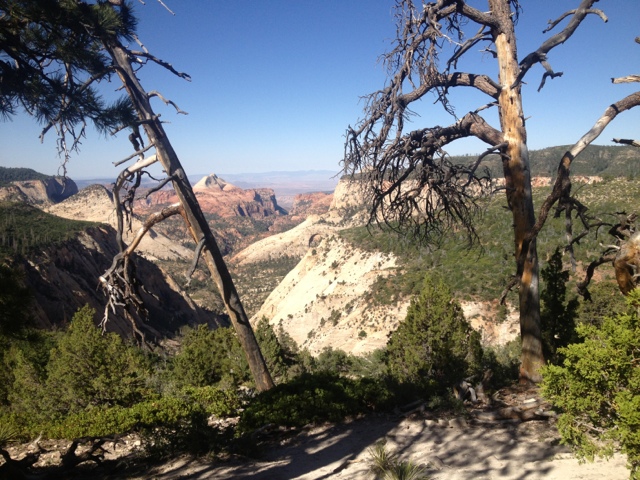
The last two miles of the hike were, by far, the most spectacular.  The trail climbed steadily above the various branches of the Black Birch Canyon.  As we hiked, the views to the East began to open up.  It seemed as if we could see hundreds of miles.  Mesas and ridges ran endlessly towards the horizon, and distant, larger mountains hung in the sky liked shadowy ghosts.  Many people have said that hiking in canyon country makes one feel small.  This section of the trail certainly had the feeling of being lost in a vast landscape too grand to comprehend.  

As the trail worked its way around Ponderosa Ridge it slowly turned back to the West.  We suddenly could see the observation platform built on Rainbow Point.  This provided the illusion of making us think we were close to the end of the hike, but the trail still had a few tricks up its sleeve.  As it turned North, the Under the Rim Trail skirted a ridge with stunning views to the West.  It climbed higher and higher, breaking out into a treeless world of red rock.  We had views in 360 degrees, with distant mesas and ridges to the East, a labyrinth of Hoodoos directly to the West and North, and the green ridge of Rainbow Point to the South.  If we looked more carefully to the Southwest, we could make out patches of snowfields on distant mountains.

We stopped for a few photos while crossing the exposed red rock.  The winds howled across the open terrain with enough force that we found ourselves crouching down while taking pictures.

On the other side, the trail climbed rapidly up the green ridge, ascending past the 9,100 feet mark.  The winds died down to more normal breezes in the forest.  We began to pass folks wandering down from Rainbow Point with cameras and flip flops - a sure sign that we were near the end.

This stretch of the Under the Rim Trail far exceeded my expectations.  We had solitude, dark forest, and stunning views for hours while exploring the more remote corners of Bryce Canyon National Park.  Tomorrow we are thinking we will visit one of the more heavily trafficked trails in the north part of the park in order to take in some more of the hoodoo formations up close.  After exploring the South end of Bryce today, though, we are more excited to go backpacking in this quiet, green area later in the week.  


Tuesday, June 18, 2013

Bryce Canyon National Park Day 1

We took full advantage of our first night with air conditioning and a bed in a week, sleeping in to the late, late hour of 9 AM. We had gotten used to waking with the sun, or even before it to escape the desert heat.  The BumbleBerry Inn in Springdale had a beautiful outside pool and hot tub with pleasing views of the sandstone cliffs to both the East and the West.  We lounged in the pool for a while, trying to soak up the comforts before heading back out on the road.

Once checking out of the motel, we used the first half of the day to run errands.  We had a hearty breakfast at a local joint, mailed post cards to family, purchased a few groceries for the next week, and re-stocked the cooler with ice.  Springdale, Utah is a very nice town, and very eager to cater to tourists.  The local businesses, by and large, sell just about anything one could desire, and the employees are exceedingly friendly.  

The only drawback to this little town on the doorstep of Zion was that everything was pricey.  I had never paid $16 for a single container of sunscreen before, for example!  I guess the saying is true about a captive audience.  

The road out of Zion was anything but routine.  It climbed past Canyon Junction, affording one last glimpse of Zion Canyon from a lofty perch.  Eventually the road reached a 1 mile tunnel, carved into the heart of the canyon wall.  Built by the men of the Civilian Conservation Corps during Roosevelt's New Deal, the Zion-Mt. Carmel Tunnel is an engineering marvel.  The crews built windows into the side of it, periodically, which provide the occasional glimpse of how the terrain is changing as the road travels East.  

Once emerging from the tunnel, we were treated to a strange terrain of sculpted slick-rock.  The road wound its way higher and higher up the Plateau as it went.  We stopped at a few scenic turn-outs for photos, and marveled at the cooler air.  By the time we were making the turn south for Bryce Canyon National Park, the air was a full 25 degrees cooler than on the floor of Zion Canyon.  

The road to Bryce traversed open country.  Ranch land bordered closely in most places, framed by the more distant mesas, and the even more distant mountains to the North.  We were lucky enough to drive by a field while men on horseback were herding cattle - actual cowboys!  All of this added to the "out west" motif to the area.

Entering Bryce Canyon National Park was quite different from most other parks.  Bryce is famous for the strange rock  formations called hoodoos.  Anyone who has watched a National Geographic or Travel Channel special on the American West has seen pictures of these famous and peculiar landmarks.  Driving into the park, though, provided no evidence of them.  The park road, which travels south from the entrance all the way to Rainbow Point where it dead-ends, is lined with grassy fields and gentle stands of pine trees.  No views could be seen in either direction as we drove into the park, found a campground and set up camp for the week.  

We were elated, however, with the cooler weather.  The air was little over 80 degrees, with cloudless blue skies overhead.  I was hoping we would find our tent and sleeping bag more welcoming here than we did in Zion, where we usually just sprawled naked on top of the air mattress and tried to think cool thoughts long enough to fall asleep.

With camp set up, it was time to drive around and try to gain an understanding of the landscape.  We drove to several points along the park road with views to the East.  This strange land was unlike anything I had ever seen.  The hoodoos began directly beneath the canyon rim, stretching for a couple of miles to the East in most places.  No two were the same.  They ranged from slender spires of limestone, to rock faces with windows cut out of them, to balanced rocks where the middle of the hoodoo was eroded away so severely as to create the illusion that someone had placed a boulder on top of the spire.  In many places the hoodoos were grouped together so as to resemble a structure, such as a sand castle.  

The whole scene was too strange to be real.  I couldn't resist feeling like it was some type  of optical illusion.  We drove the park road all the way to Rainbow Point.  At over 9,000 feet of elevation, this point allowed stunning views of both the hoodoo formations, and of the distant  mesas and mountains of the Grand Escalante National Staircase, stretching to the horizon in the East.  

On our drive back to camp the road was lined with, and even occasionally blocked  by, pronghorn deer.  The park is also home to elk, black bears, mountain lions and prairie dogs, to name a few species, but we have yet to see any of these.  

After cooking up some delicious stir-fry for dinner in camp, we headed to the Bryce Lodge for the evening program.  Ranger Geoff gave a surprisingly interesting presentation on the geology of the park.  I say surprising, because I have seldom found geology to be of interest.  I think its the large spans of time involved. I can understand how it took 50 million years for something to form, but it just isn't interesting to me, seeing as no one could sit around and watch it happen.  To his credit, Ranger Geoff's presentation was highly engaging and left me with a much better understanding of the processes that sculpted this bizarre landscape.  The ranger said that he taught astronomy the rest of the year, when he wasn't working at the national park.  His students are lucky to have a teacher who is so engaging and full of wonder at the natural world.

In the morning we made some breakfast and packed the day-packs for our first day hike in the park.  I was eager to explore this new terrain.  We selected the Peekaboo Loop Hike for our first ramble. A 5.5 mile hike of moderate difficulty, the Peekaboo Loop takes hikers from high on the ridge at Bryce Point down into the heart of the Hoodoos, and back out again.  We quickly learned that one downside to starting on the rim of a canyon is that you have to hike back up at the end of the day.

The trail left Bryce Point via a long and steady switch back down a moderately steep rock wall.  Pinyon, Juniper, Ponderosa and Limber Pines grew sporadically along the trail as it worked its way towards the lower elevations.  Clark's Nutcrackers, a western relative of Blue Jays, darted among the trees as we hiked.  
About half way through the descent, the trail passed through a short tunnel in the red rock.  This would be the first of several tunnels on the Peekaboo Loop Trail.

Upon reaching the bottom the actual loop portion of the hike began.  We chose to turn left and make the hike in a clockwise direction, but I think it could done either way with little difference.  The trail worked its way through the maze of hoodoos.  We would climb steeply up a wall via tightly woven switchbacks to reach a pass or tunnel and then drop back down the other side, only to repeat the process again.

The trail surface was loose rock with a coating of sand.  It was unpredictably slick, and required slow and careful food placement.  We found the 5.5 miles to be very slow going, and tiring.  

Hiking through the Hoodoos themselves was fascinating.  I felt as if I was walking through a life-size series of sand castles, or perhaps through a strange, beach themed miniature golf course.  None of it seemed real.  Occasional windows in the rock faces would provide unique photo opportunities of the more distant landscapes.  

Once completing the loop portion of the hike, we made the tiring climb back up to Bryce Point.  The weather was pleasant and mild throughout our hike, with blue skies framed by red rock formations.  

This is a bizarre place, and unlike anything I have seen before.  We are planning several more day hikes in the park, and a backpacking trip.  Hopefully by the end of the week I'll have a better grasp on this unusual landscape!  


Sunday, June 16, 2013

West Rim Backpack

The West Rim Trail in Zion National Park runs south from the Lava Point trailhead in the Northwest corner of the park.  This trail starts out at over 7,000 feet of elevation and, following the Horse Pasture Plateau, winds it way gradually towards Zion Canyon.  Upon reaching the west rim of the canyon it rapidly switchbacks through stunning side canyons all the way to the floor of Zion Canyon at the Grotto Trailhead.  This is arguably the premier backpack in Zion. We were really hoping to have the opportunity to hike the West Rim.

Taking on the West Rim entailed securing one of the limited permits issued for backcountry campgrounds in the park.  About half of the backcountry campsites in Zion are available for reservation far in advance of the intended trip.  The rest of the sites are available on a first-come first -served basis starting at 7 AM the day before the planned hike is to begin.  By visiting the Wilderness Permit Page on the Zion Webpage back home, I had determined that we had no shot of reserving a campsite in advance.  I honestly don't know who the people are that are able to plan their trips so effectively so far in advance as to nail down the exact nights and locations of their backpacking trips months before leaving home.  More power to them, I guess, but I am certainly not one of them.

That stated, our remaining choice was to shoot for a walk-in permit the day before our hike.  I set the alarm for a pre-dawn wake-up on Thursday morning.  I was in line outside the visitor center by 6:15 AM.  I had decided that forty-five minutes was the maximum amount of time I was willing to commit to waiting in the dark.  Five people were in line when I arrived there, and judging by the camp chairs and blankets, they had been there a while.  It would turn out that all of them were seeking permits to thru-hike the narrows, or enter the "subway" a super-hard slot canyon few visitors ever reach.

My gamble paid off, and by 7:30 I was out the door with permits in hand.  I was able to secure my first choice of campsites for both Friday and Saturday nights.  This would allow us to segment the 14.2 mile trail into three very short stretches.  This seemed like a really easy hike in comparison to our other wanderings, but backpacking in the desert was still a very new phenomenon to me.  I was afraid that the mid-day heat would overwhelm us, or that we would run out of water high on the plateau, or that a rattlesnake would bite or us, or - well, suffice it to say that I wanted to be cautious on our first desert backpack.  Besides, nothing wrong with having some time to kick back and relax in the hammock somewhere quiet!

We spent the rest of Thursday relaxing in the shade and preparing for our backpacking trip.  There were some exciting new details to consider with a desert trip.  It would seem that we would not need a number of items, seeing as it doesn't ever rain here.  We decided to leave behind our rain fly to our tent, our tarp, our rain gear, our pack covers, and any clothing that we weren't going to wear while hiking.  All of this was intended to balance out the added weight and space of carrying additional water.  

We usually only leave a trailhead with 6-7 liters of water for the first day of a backpack.  Finding more along the way hasn't been an issue in the East.  The map indicated the presence of a spring near our first night's campsite, but again, being nervous about the reliability of this water source I wanted to carry enough in case it wasn't flowing.  The compromise we settled on was 10 liters.  We also decided to carry the bear-canister for our food, even though bears aren't much of an issue in Zion.  Although it added weight, it would keep the squirrels and chipmunks at bay.

The last issue we needed to resolve before such an undertaking was finding a shuttle to the trailhead.  Lava Point lies about 45 minutes by car north of Springdale.  I had taken the liberty of reserving a ride on a 7 am shuttle with the Zion Adventure Company a few weeks back in the hopes that we would succeed in securing a walk-up permit.  The shuttle service wasn't cheap, but the option of doing this hike as a thru-hike was worth every penny.

My cell-phone alarm went off at 5 am Friday morning.  Neither of us had slept particularly well during the night.  A steady blast of wind came down through the canyon throughout the night, tugging at the tent stakes in all directions.  We were forced to pack up camp and finish preparing the backpacks in the pre-dawn dark while fighting with the gusty winds.  The good news was, at least it wasn't hot.

We made it to the Zion Adventure Company's parking lot with enough time left to apply sunscreen and double check the packs for last-minute additions.  The shuttle left promptly at 7 am.  A large van, either a Sprinter, or like one,  with extraordinary head room, it had room for more than ten hikers.  This particular trip took three couples to their hikes.  One couple was headed the trailhead for the Wildcat Canyon, another trail that could be linked with West Rim for a longer backpack.  The other couple, young, athletic looking folks with European accents, was headed for Lava Point as well.  They were planning to hike the West Rim as a day hike - a very long one.

The shuttle ride was worth the price alone.  John, our driver, gave us a narrative of the area's history and significance of certain locations - including his own personal cabin and the giant boulder that crashed through his fence in the middle of the night.  John said he had laid awake for several nights afterwards imagining that each sound was another rock headed for his home.  Stories like this remind me of how lucky we are in Michigan without natural disasters.  The ride also took us by a road that lead to the filming location of Butch Cassidy and the Sundance Kid.  

The road north towards the Kolab Reservoir was a wild one.  It wound through a portion of the Southwest Desert before climbing high into the desert plateau.  Gradually, the vegetation changed over to pine, and the hillsides took on a green hue.  We were all surprised to find the terrain so close to the desert to be so full of growing things. John told us that he often sees elk in this area.  Our ride was briefly interrupted by a llama, as the shaggy, white haired fella wandered into the middle of the road and just stared at us for a time.  I had the impression that we might be the only car to come this way that day.  

As we approached Lava Point, the road became rough and rutted.  John paid this no mind, flying down the sandstone-red path at alarming speeds.  Several of the bumps in the road sent us flying out of our seats.  Mary remarked that this mighty be the reason for the tremendous head room!

Eventually we reached the trailhead, and we were on our way.  The trail was surprisingly mild on our first day.  It climbed very gradually through a lush forest, interrupted occasionally by hills of bushes and cacti.  Many of the cacti had bright colored flowers opened in the direction of the sun.  The hillsides were covered in many places with a variety of other wildflowers.  I am not great at wildflower identification, but I did notice Indian Paintbrush and Honeysuckle in many places.  

The weather high on the plateau was heavenly.  The added 3,000 of elevation had the effect of lowering the temps by at least 10 degrees, and a pleasant breeze drifted through the wilderness.  Occasional views of distant mesas and canyons peaked through the vegetation.  

We arrived at campsite #7, our home for the night, before noon.  So much for a rough day!  The site had a couple of giant  pine trees on either side of it, providing for consistent shade on some part of the site at all times.  The views were somewhat limited from here, but the hill directly below us was covered in cacti - all clad in brightly colored flowers.  It was like we had our own flower garden.  

The search for water took a few minutes. We ended up locating the spring about 3 tenths of a mile from our site, down a side spur trail for campsite #6.  The spring, called Potato Hollow on the map, turned out to be a pleasant place to relax while filtering water.  Literally and oasis in the desert, it was the only source of water for miles.  Birds swarmed around the tall marshy grasses on its edges throughout the day.  The most common bird we sighted was the tree swallow - its bright green back flashing in the sun as it darted through the air and to the surface of the water.  

With plenty of water available, we spent the afternoon and early evening relaxing in our hammock, strung between two young Aspen Trees, in a thick stand of Honeysuckle.  We read books and relaxed in the shade, even tolerating the steady stream of bees that came by to visit the flowers near us.  Occasional hummingbirds zoomed by, and one looked like he was thinking about trying to feed from our hammock.  Maybe the red color confused him!

In the evening the winds picked up and the sun dropped below the hills to the west.  The air rapidly grew cold.  We fixed a boxed meal of couscous for dinner.  The chocolate bar we packed melted - covering everything in the food canister with a thin layer of chocolate.  We ended up scraping the dried-on chocolate off of many of the items as our desert.  So much for my theory that high percentage chocolate doesn't melt.  In the desert - everything melts.  Still, it was hard to complain.  We had a beautiful meadow to ourselves for the night.

We both intended to stay up late to watch the stars, but the cold night air coupled with our poor night of sleep the previous night lulled us to sleep within minutes of darkness.  During the couple of times I awoke during the night to shift sleeping positions I was treated to a blanket of stars that stretched from one horizon to the next.  The air was cold, and the world outside our tent was wonderfully quiet.  

In the morning we woke to the sun's hot rays streaming through the tent, directly onto our faces.  We prepared some grits for breakfast, with plenty of hot coffee.  I went back to the spring to filter more water.  Our campsite for Saturday night would not have any water source.  Mary packed up camp while I fetched water, and in no time we were ready to hit the trail.  Loaded down with 15 liters of water - enough for the rest of our hike, we hoped, our packs were suddenly very heavy.  

The trail threw us a bit of a curveball to start day two.  It left Potato Hollow via a steep and steady switchback up and over a green ridge.  We were both huffing and puffing within minutes.  Eventually, we did break out onto the ridge, earning views in several directions.  Looking behind us gave us a neat perspective on our campsite for the night and the surrounding area.  

The trail followed the edge of the plateau closely the rest of the day, affording remarkable views of the towering temples and deep, dark canyons on both sides of us.  More distant and prominent mountains could be seen to the West.  We passed a group of hikers - the first we had seen in 24 hours, near the junction with the Telephone Canyon Trail.  We both marveled at how none of them seemed winded, or dirty, at all.  We always feel like we are covered in filth, soaked in sweat and exhausted while backpacking.  Many of the hikers we have encountered on the trail out here must run triathlons in their spare time - they never look tired or bothered by the heat!

Passing the junction with the Telephone Canyon Trail, the West Rim Trail passed through an open scrubland that looked to have suffered through some forest fires.  The views to the west were beyond description.  Looking west from the plateau had the feeling of standing on the surface of the moon, or an alien planet perhaps.  

We were delighted when we found the post for campsite #5 near a thick stand of pine trees.  The short spur trail lead to a perfect little site - set in a stand of trees providing shade, and with views into Telephone Canyon, and across the Narrows to The Mountain of Mystery.  We set up our camp and spent the afternoon relaxing in the hammock and reading in the tent.  

In the evening, we were treated to a stunning sunset a short walk from our tent.  The sun melted, like butter, into the alien landscape of rounded gray temples, towering sandstone cliffs and distant mountains.  The whole terrain was awash in a bluish light as the sun vanished for the night.  

The air that night grew cold, and the winds raged across our narrow little spit of land.  We were wishing we had packed more clothing as we crawled into the tent for the night - but once in our down sleeping bag we slept comfortably.  

We awoke in the morning in time to watch the sunrise over the green, gentle slope of the Mountain of Mystery in the East.  After a quick breakfast we were back on the trail.  The last day promised the most spectacular scenery.  

The trail wound its way around the remainder of the Horse Pasture Plateau, providing steady views to the West and eventually South.  The dark chasm of Behunin Canyon dominated the scenery for a while.  At the junction where the Telephone Canyon Trail re-joined the West Rim Trail we began a rapid descent down the face of a sheer cliff.  The trail was only 3-5 feet across in most places, and the drop offs into the canyon were terrifying.  We picked our steps carefully as we descended the steep trail.  

Eventually, the trail arrived at a bridge across the remaining depths of a side, "hanging" canyon.  We stopped for a snack break just beyond the bridge, before beginning the climb up the other side of the canyon.  The trail switchbacked through a red sandstone world back out of the canyon, reaching a gray colored rock surface.  We were treated to a fairly level walk across open, rocky terrain for a while.  Signs installed by the park service aided in locating the trail.  It eventually resumed descending, and in no time we were arriving at Scout Lookout.  Scout Lookout is where the quiet solitude of the West Rim Trail meets to the crowded mayhem of the Angel's Landing Trail.  

Angel's Landing is the most famous day-hike in Zion.  Only a short, but steep climb up from the Grotto, it offers un-equaled views of the canyon floor.  Most of the hike, the part that reaches Scout Lookout is a hard, but safe series of tightly woven switch backs through Refrigerator Canyon.  Called Walter's Wiggles, these switchbacks make this lookout accessible to just about any hiker.  Beyond the lookout, the  half-mile trail climbs out onto a narrow mass of land jutting into the canyon.  The trail had chains bolted into the side of the rock in many places to aid in the climb.  Angel's Landing is quiet famous, partly due to the fact that six hikers have fallen to their deaths since 2004, a fact the park displays prominently on signs at the base of the climb.

I was on the fence about doing the climb, and Mary wanted no part of it.  She agreed to stay with the packs while I explored the trail.  I wasn't sure how far I would get, intimidated by the climb's reputation.  The trail climbed unpredictably, snaking around one side of a mass of rock, before switching to the other side, and then occasionally going straight up and over steep rocks, requiring climbers to hold on tight to the chains and pull themselves up to the next level.  Through all of this, the trail never ventured more than a few feet from the 1,500 foot sheer drop-off to the canyon floor.  

I was happy to find that the "cliff exposure," as the warning signs call it, wasn't as bad as I anticipated.  In most places, it's reasonably safe, as long as you don't go too fast and don't let go of the chains near the edges.  The steady stream of hikers moving in both directions might be the most challenging aspect of the climb.  Most were very responsible,though,  taking turns, and deferring to the down-hill climbers in the narrow spots.  The hike was harder from a cardiovascular perspective than I expected.  In places, the steps were quite far apart, even for my long legs.  

I reached the top in about thirty minutes. My legs were trembling from the workout and my chest heaved with exhaustion.  I stopped long enough to marvel at the view and snap a few pictures before beginning the return trip.  The down-climb was actually easier than I expected.  I elected to sit on my bottom and scoot down some of the steeper sections, while holding on to the cables for support.  In a  few minutes I was back at Scout Lookout .  I only saw one person freak out and turn around on the chains in the time I was up there. 

Reunited with Mary, I was happy to finish our backpack and seek some cold drinks and non-dehydrated food.  We made the descent through refrigerator canyon in short time, and soon were at the Grotto Trailhead waiting for a bus.  My knees are sore after a day that included more than 4,000 feet of descent on mostly hard rock surfaces, but I am delighted with the beautiful experience we were able to have in the backcountry of Zion.  

We decided to check into a motel in Springdale for the night.  We need a chance to shower, wash laundry and buy groceries for the next leg of our trip.  We had an early dinner at Pizza and Noodle - a cool local place with great pizza and air conditioning ( a must).  Tomorrow we leave for Bryce Canyon.  We have thoroughly enjoyed out time in Zion National Park, but we are looking for ward to the cooler temps in the high elevations of Bryce.  


Wednesday, June 12, 2013

Zion Day 3: The Narrows

If Zion National Park is famous for one thing, it is the Narrows.  At the top of the main canyon the walls of Zion Canyon close in around the Virgin River for several miles.  This long section of steep canyon is incredibly picturesque and sometimes perilous.  If a sudden thunderstorm pops up somewhere in the headwaters, possibly hundreds of miles away, a wall of water can come crashing through the canyon sweeping everything and everyone in its path away.  Flash floods played an important role in the formation of the canyons and continue to play a key role in the various ecosystems that call Zion home.  That said, they are nothing to mess around with.  A hiker caught in the Narrows during a flash flood would have poor chances of survival.  

Doing the Narrows as a thru-hike requires obtaining a hard-to-get permit, securing a shuttle from a private outfitter to the north entrance, and completing an arduous 16 mile trek through the Virgin River.  The more common, and approachable way to experience the Narrows is hike up hill (or upstream) from the north end of the Riverwalk at the Temple of Sinawava.  Doing the hike in this way allows one to hike as long as he or she wants before turning around.  This was our plan today.  

We caught the shuttle from the visitor center after breakfast, and judging by the capacity crowd riding the bus with us, it was going to be a busy day in the Narrows.  It was easy to spot hikers heading for the Narrows by the water shoes, swimsuits and wading poles used to help negotiate the rocks and varied depths on the bottom of the Virgin River.  


Sure enough, all but a few of the riders on the bus road all the way to the Temple of Sinawava.  It was an unusual experience to be hiking a trail with hundreds of other people and reminded me of the Avalanche Creek hike in Glacier National Park.  The crowd heading up the paved Riverwalk trail included all manner of hikers, from children to intrepid-looking adventurers in their twenties, to senior citizens and folks in wheelchairs.  The riverwalk wound between the increasingly narrow canyon walls, always within sight of the crystal clear waters of the Virgin River.  After an easy, one mile walk, the trail ended at a platform overlooking the river.  A set of steps lead down to the sandy beach, and this was it for man-made trail features.  

The morning air was still cool, and the steep canyon walls blocked the sun this early in the day.  The first few steps into the river were alarming to the skin.  The water, derived from snow melt in distant mountains, and springs throughout the canyon, was about 50 degrees.  The path upstream wound from one side of the river to the other.  Occasional sandbars with scatterings of trees and bushes provided relief from the cold water and awkward footing of the river.  The canyon walls gradually grew in height and closed in around the river on both sides.  

After about an hour of careful walking in and around calf-deep water the walls rapidly closed in around the river.  The sandbars and trees became less frequent, and the water deeper and faster.  It was now necessary to wade through deep holes in the river at times.  The views became increasingly spectacular.  Sandstone walls measuring in the thousands of feet in height closed in around the canyon.  Hanging gardens, growing from seeping springs in the rock walls dangled down over the river.  An American dipper darted down to the surface and landed on a rock.

The Dipper, also called a water ouzel, is a fascinating western bird.  This favorite of naturalist explorer John Muir lands on rocks on the surface of the river and "dips" his head up and down while surveying the river for bugs.  When he spots one, he dives under the surface of the water and flaps his wings in order to swim through the water.  The American Dipper is the only bird known to exhibit this behavior.

Somewhere after the junction with Orderville Canyon the air finally began to grow hot in the midday sun.  What an ideal way to spend a day - wading knee (and sometimes waste) deep through cold, crystal clear water on a hot sunny day, all while gazing up at monoliths carved from sandstone over several million years.  The formations in the sandstone very much reminded me of Michigan's Pictured Rocks, only instead of 200 feet tall, they towered 2,000 feet over our heads.

We stopped for lunch on a rock somewhere past Orderville Canyon.  The canyon walls seem to be opening up finally, letting in more daylight in this portion of the hike, so we decided this would be our turn-around point.  

After lunch we began picking our way downstream in the much warmer air.  Walking with the current was actually harder than against it, as the force of the water threatened to knock us over as we fought for precarious foot placement.  I tried to make use of my knowledge of water from whitewater kayaking classes, but to little avail - it was just hard work.

When we returned to the junction with Orderville Canyon we decided to take a side trip up this narrow canyon.  Mary found a nice rest spot on the banks of the river while I hiked farther up the canyon.  A handful of other hikers headed up the same canyon.  This side canyon climbed much more steeply than the Virgin River.  I had to pull myself up, over and around a variety of obstacles in the river.  The most challenging of these was a 3-4 foot water fall.  On the left side of the river was a large sandstone rock blocking the path.  The middle featured a "notch" with several logs and rocks.  On the right side was a large waterfall.  

My first approach was to scramble up the sandstone.  The sandstone turned out to be very slick, and I ended up sliding backwards into the river.  Next, I tried the middle route, but found it too awkward to get the needed foot and hand holds to pull myself up.  The third route, climbing up the waterfall was dubious.  I got about half way up the cascade, but found the force of the water too strong to overcome.  

Just when I was about to give up, a teenage girl came along.  She wedged her feet into the rocks in the middle of the river and squeezed between the downed trees and pulled herself to the top.  Now I had no choice.  I could do the same thing, or look really lame in front of a crowd of hikers gathering at the base of the falls.  She offered to take my trekking pole for me, which made it a bit easier to get a grip with two hands.  I managed to get my feet wedged into the rock, and grabbed ahold of the top of the obstacle.    This left me in an uncomfortable position, with me feet tucked under me and my arms essentially behind and above me.  I was forced to turn sideways and shimmy up the rest of the way.  My day pack dragged loudly on the downed-tree, but happily did not prevent me from reaching the top.  

Above the obstacle, and with my pride intact, I resumed climbing up the river.  Their were a few more obstacles to get around, but nothing seemed too daunting now.  The canyon rapidly opened up now, allowing the hot sun to stream through.  Many trees and shrubs grew on both sides of the river.  After about thirty minutes I reached the waterfall I was seeking.  A five foot slot waterfall blocked further passage up the river, or at least that's what my guide book said.  Today, there was a large downed tree pinned in the falls.  I think it might have been possible to climb over this obstacle today and venture farther into the side canyon.  I didn't want to keep Mary waiting any longer, so I decided to call this far enough.

When I returned to where I had left her, Mary was asleep on a rock on the banks of the river.  She had no idea how much time had passed.  Looks like I had nothing to worry about!  

We made our way back into the main canyon and continued downstream.  The air was now hot, and the sun shone directly overhead.  The canyon was crowded with hikers headed in both direction.  People swam, waded and just plain floated in every direction.  The afternoon light flooded into the canyon, casting enchanting shadows on the walls and water.

We made our way back out of the canyon the way we had come, stopping to swim periodically, whenever the afternoon heat become too much. 

By the time we climbed back aboard the shuttle bus, we were ready to collapse with exhaustion.  There are only so many things in life that live up to their reputations.  The Narrows of Zion are certainly one of them.  As I look back over my pictures from the day, I am frustrated, because they do not come close to doing justice to the spectacular beauty of this place.  Today was a magnificent day of exploring.

.  


Tuesday, June 11, 2013

Zion Day 2: observation point

The alarm sounded at 5:30 am this morning.  The air was still chilly outside the tent and the sun was well hidden behind the east canyon walls.  We made a quick breakfast, loaded up our day packs with water and headed off for the visitor center to catch the park bus.  We had learned our lesson the previous day about getting an early start.  The morning air was cool and refreshing. 

We took the bus up to the Weeping Rock trailhead we had visited yesterday, but today's hike would take us way up into the high canyon walls to observation point for a dramatic overlook of Zion Canyon.

Just passed the trailhead was sign warning that people had fallen to their deaths on this trail in the past.  The trail started innocently enough.  The surface of the trail was a hard rock that almost looked paved, but wasn't.  The trail switchbacked for about 500 feet, climbing the canyon walls.  Even in the early morning cool, we were both huffing and puffing by the time we reached the intersection with the Hidden Canyon Trail.  The parking lot and road below looked like something out of a matchbox set by this point.  The  walls of the West Canyon started to glow orange in the growing sunlight.  


We were treated to an aerial show by two Peregrin Falcons.  They dropped down off a cliff above us and plunged towards the canyon floor in pursuit of a song bird.  Peregrin Falcons can fly over 200 miles per hour when diving from a high point.  Watching them reminded me of fighter jets in a dogfight scene in a movie.  

Following the junction the trail continued to switch back high over the canyon floor.  We could soon see past Big Bend, where the Virgin River snaked around Angel's Landing.  The drop offs on the canyon side of the trail rapidly grew as we hiked. We were certainly close to a thousand feet over the canyon floor.  

I was expecting the trail to continue switchbacking all the way to the top of the wall.  It was a pleasant surprise then, when it turned into a side canyon and began to work its way back away from the main canyon.  A slot canyon appeared to one side.  The floor of this new canyon gradually climbed up to meet the trail.  Trees grew on all sides of the trail during this stretch, evidence that water does find its way down this canyon during floods.  We were glad today wasn't one of those days!

As the trail continued to climb through the canyon the walls turned to sandstone - a brilliant shade of orange that I would expect to find in a contemporary living room.  The air was cold and crisp in these enclosed canyon walls.  Every sound we made echoed into the abyss below us.  


  The trail eventually broke out onto the other side of the wall.  We were now on the East side of the canyon wall.  The sun shone down relentlessly.  I was glad we started hiking early, as the air was quickly becoming oppressively hot.  The trail resumed switch backing up the East side of the canyon wall.  The views to the East were spectacular - towering domes of rock stretched as far as the eye could see.  The trail was lined with Juniper and Pinyon Pines and the occasional cactus.  It was a surreal environment to hike through. 


After an hour of climbing through the hot desert sun, the trail finally broke through to a ridge.  It climbed gradually along the ridge and made its way back to the west side of the canyon wall.  We were then treated to a soft sandstone and sand trail surface for hiking and occasional shade from Ponderosa Pines and large Pinyon Pines.  The views were now to the West - providing a stunning perspective of Zion Valley.


We broke out onto a large flat area - the top of a messa.  We were surrounded by low brush and cacti through this stretch of the hike.  The trail was delightfully flat as we made out way the rest of the way to observation point. 

The views from observation point were stunning.  The Virgin River looked like someone had drawn a scribbly line in the sand with a pencil.  Angel's Landing was south and below us.  With my binoculars I could make out people standing at the edge.   Vultures, Ravens and White Throated Swifts circled high overhead while we ate our lunch.  


After a lengthy lunch break to enjoy the views, we made the knee-pounding descent back to the trailhead the way we had come up.  The mid-day heat settled in, and the hikers passing us on their way up looked miserable!

We finished our hike in a little under five hours.  We took the shuttle bus up to the Zion Lodge and treated ourselves to ice cream cones.  The afternoon was spent napping in the shade underneath a giant Cottonwood Tree in front of the lodge.  Not bad for a Tuesday!